
Each year in early September, we read the many stories of remembrance and reflection on the 9/11 terror attacks in New York.
Today, 25 years on and drawing on the archives of Asset (as the launch editor, I’m privileged custodian of the last remaining, early back copies), the excerpt below depicts a firsthand account from one of a group of travelling Australians present when the planes hit the twin towers.
That piece was published in October 2001, featuring a raw and emotional account by Mark Spiers, then CEO of ING Financial Planning, who had travelled to New York with a group of Australian colleagues for the US FPA conference.
Many Australians were impacted. 10 died that day.
One survivor, Hans Kunnen, of Colonial First State was lucky to escape and later told his harrowing account of surviving the attack. Hans had been attending an everyday industry event: a breakfast meeting of economists, held that morning in the World Trade Centre Marriott Hotel.
Mark Spiers was two blocks from the World Trade Centre when the first plane hit.
Back then, Asset asked Mark’s permission to run his story because it was, in the truest sense, primary source material and compelling storytelling. Handwritten on the plane home, while the shock was still raw, and also what Mark called his private form of release.
Twenty-five years later, I still think about that hand scrawled and emotional piece. Not because it explains September 11, but because of what it captured about ordinary people. Not just the almost 3000 souls who lost their lives, but the Australian financial services people and our relationship to that day.
An industry that happened to be there
Financial services conferences are fairly itinerant. Advisers, fund managers and executives fly constantly, and in September 2001, lower Manhattan was a popular gathering point. Mark was among a large contingent of industry folk there that day.
His group had been in briefings with US financial services leaders the day before. They were walking toward the towers for exactly the reason thousands of others were. It was a Tuesday, and there was work to do.
That ordinariness is part of what makes Mark’s account very real. The piece opens with the mundanity of a conference trip: cabs, traffic, breakfast conversation. His documenting of a normal working day suddenly becoming a historical, terrifying one, is worthy reading, not least as a prelude to the many global impacts, including a 20-year long war in Afghanistan, and continuing political and economic turmoil in our world.
“We all will harbor feelings of some kind – we should recognise and understand them and use them to learn to live in better and wise ways.”
MARK SPIERS
What Mark’s account still teaches
Re-reading the piece now, three things stand out for me.
The first is the value of a plainly written, unpolished eyewitness account. Mark wrote that he began writing to “pick himself up”. Sort of a cathartic way to process what he’d seen. He was trying to get the day out of his body onto paper.
Retrospectives written with hindsight tend to smooth an event into narrative; accounts written in the immediate aftermath keep the lived and small details of disorientation, the false conclusions (“it must have been a gas explosion”), the human details – a woman on a loudhailer, a lady tumbling out of a phone booth, taking his safety cash out of an ATM.
The second is a point Mark made public about his own life: being busy in a career had, in his words, limited the depth and frequency of meaningful connections with family and community, and that the terror attacks forced a reckoning for him. This theme recurs constantly in accounts from people who survived or narrowly missed the towers that day. A sudden, forced clarity about priorities in life.
The third is about organisational response under extreme pressure – visible both in Mark’s account of New York’s emergency and business continuity systems functioning under the worst possible conditions, and in what came after at firms like Cantor Fitzgerald, which rebuilt itself while establishing a relief fund that has since distributed over $300 million to affected families, and made a standing commitment to employ the adult children of the employees it lost.
Business continuity and crisis planning, before 2001, was a compliance checkbox for most financial services firms. After it, for an entire generation of leaders, it adopted more a moral obligation.
A historic moment
Mark closed his account by describing New York as a city he’d remember for its people rather than its skyline. He described their compassion, loyalty and organisation in the face of a defining, traumatic event.
Twenty-five years on, that seems like the right note. September 11 has reshaped global security policy, aviation, immigration law and geopolitics in ways that are still working themselves out.
But inside financial services, it left something more particular: a reminder that our industry’s people are not spectators to history, and that the ordinary act of turning up to a conference can, without warning, place you inside it.
I am grateful to Mark Spiers for allowing us to publish his account back then in 2001, and for the reminder, a quarter of a century later, of what that Tuesday actually felt like on the ground.
+++
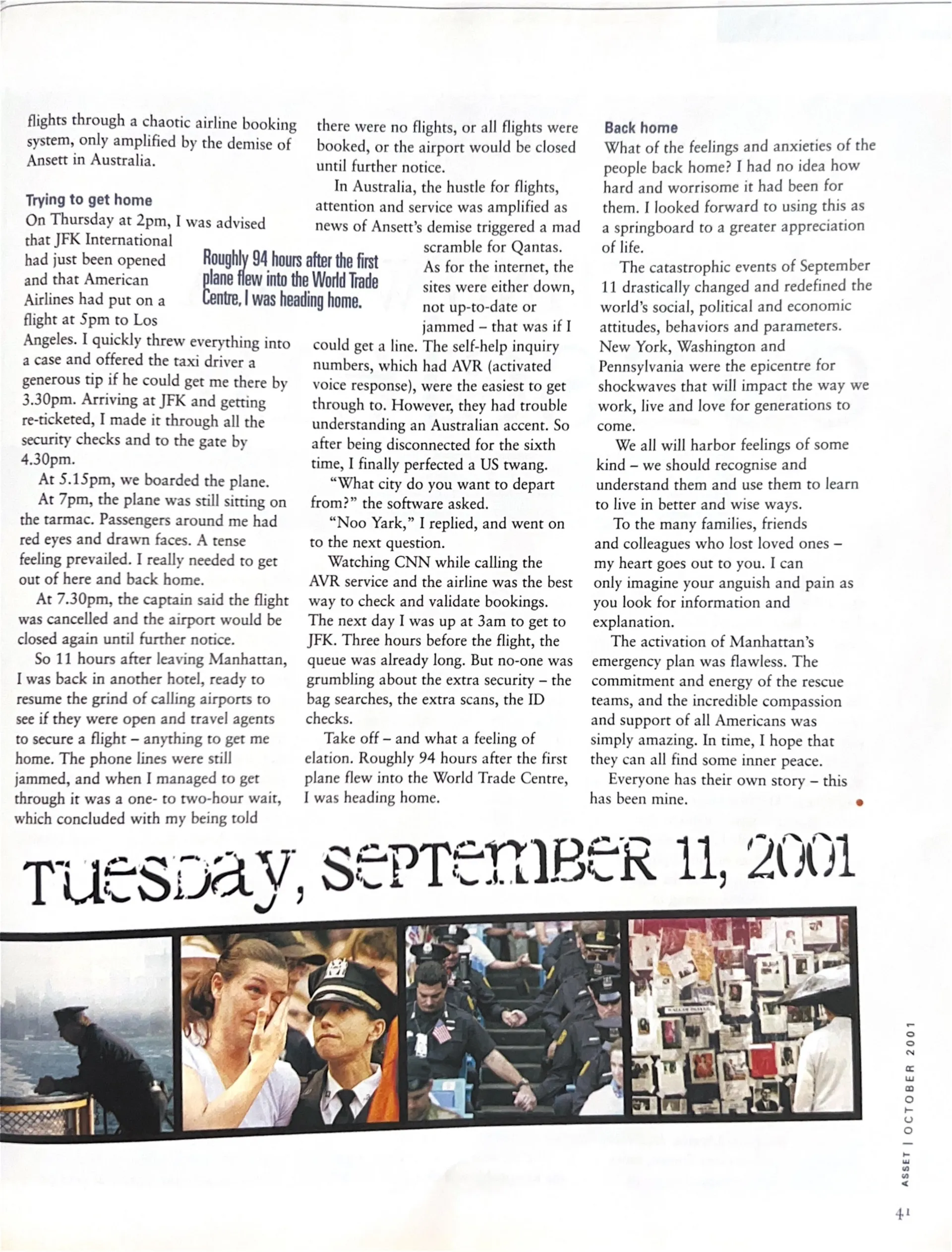
Excerpt from Asset magazine, October 2001, pp. 37–41
INDEPTH | NEW YORK TERROR
Tuesday, September 11, 2001
One man’s walk through the streets of New York
Mark Spiers, chief executive officer with ING Financial Planning, was in New York with several Australian colleagues en route to the US FPA conference when the terrorists attacked. On the plane back to Australia he wrote his thoughts as a private form of release. Asset asked his permission to publish this account to give others an insight into what it was like on the streets of New York that terrible day.
My outlook on life, like so many others exposed to the horrific events of September 11, has been indelibly altered and, I would like to think, enhanced. One has to find a way to learn from these events to live a better, fuller and improved life. While never forgetting, we must move on.
As I sat at John F Kennedy airport on Thursday, September 13, trying to get home, I felt quite melancholy. But it finally dawned on me how lucky I was – how much I have to look forward to, the opportunities and life I have yet to enjoy with my family and community. I reflected on the tragedy of another event nearly 40 years earlier – the assassination of President Kennedy – while I sat in this massive airport commemorated to his achievements. That event, a milestone of the 20th century, reshaped and redefined many US and indeed global social, economic and political aspects, just as the events of September 11 will.
Unlike so many others, I am not physically harmed, nor have I lost any family, friends or colleagues. But despite witnessing the events from a relatively safe harbor, albeit all too close, I have been deeply affected.
To pick myself up out of my reverie, I began writing about my experiences. I hope I can use it as a cathartic way to capture, release and understand feelings, emotions and thoughts that have caused me great upset when I reflect on the sights, sounds, smells and tastes of that fateful day.
I am sure there are several inter-related and connected tragic events I have experienced in my life that I have bottled up and failed to release, confront or share my feelings about, or thoughts that have fed the disbelief and despair I have felt.
As I write, I conclude that a busy life has limited the depth, strength and frequency of the meaningful connections I have with my family, friends, colleagues and the community. I, like so many of my peers, have always struggled to gain and maintain a balanced lifestyle, using the demands of my career as an excuse, and finding the shortest way to cram the most in. My family deserves more and there is much more I can give.
The attack
Tuesday, September 11, started on a positive note. The day before I had been on a study tour with a group of financial services colleagues. It had been a fruitful day of presentation and discussion from some of the global leaders and providers in financial services. Over dinner that night and breakfast the next morning we discussed much of what we had heard.
As we ate, there was the anticipation of another full day of learning from high-calibre executives from major global financial services forums.
At 8am, we hopped into cabs for the trip downtown. According to the driver, the shortest route was locked up, so we headed east and then south across town, to follow the East River along Franklin D Roosevelt Drive. Passing Manhattan Bridge on the left, we were soon at Brooklyn Bridge, with the World Trade Centre towers in our sight. Up State Street, a dog-leg into West Street, and we quickly approached the monolithic twin towers.
Before long we were passing the South Tower, Tower 2, and then alongside the North Tower, Tower 1.
BOOM. My ears popped. I said to my colleague: “That was an explosion, a bomb.” We looked up and saw a large fireball blow out the side of Tower 1.
“Put your foot down and get out of here,” we said to the driver, who immediately increased his speed.
Was it a bomb or a gas explosion? Our minds discounted the unthinkable and filed a gas explosion as the probable cause. We sped around the corner and into Greenwich Street, two blocks south of the World Trade Centre, stopping in front of the Salomon Smith Barney building.
What do we do? We had to meet our colleagues who were following behind in other cabs. Out on the street we asked a man what had happened. He said he saw a plane fly into the North Tower. It appeared to have engine problems. On a clear day with plenty of harbor and river to land on, it didn’t make sense – could it be deliberate? Our minds didn’t allow us to believe this as a plausible conclusion.
In the foyer of the Salomon Smith Barney building, we met our Salomon contact. He told us that the others, some who had left before us, had not arrived yet. We hoped that the debris from Tower 1 that showered down behind us had not caught them. As it happened, it had rained down, and they had a lucky escape. They had dodged a piece of debris the size of a fridge and turned back to the hotel, witnessing the second plane hitting Tower 2.
Our Salomon contact had a pocket e-mail pad that beeped at him in the foyer just as people poured out of lifts with focused faces reflecting anxiety and disbelief. The e-mail simply said: “Second jet into Tower 2 – evacuate!”
With that, we all poured out on the street where, after discussing whether we should stay or go, we decided we would wait for our other colleagues who hadn’t turned up.
It was now confirmed that a plane had flown into each tower. “Must have been terrorists,” we concluded. On the street we were frozen to the spot while people looked for colleagues, fears rising for friends and family in the towers.
The mobile network was jammed. There were long lines at pay phones. Above us, the flames previously visible only externally had turned inward, and now smoke was billowing out from the upper floors and floors below the point of impact as aviation fuel poured down, forming a river of fire.
People were visible hanging out of the windows on the floors above and around the points of impact as smoke and fire pushed them to break the glass, allowing more air to fuel the fire. The terror they must have felt! The smoke was akin to a pall from a nuclear mushroom cloud – there was no chance of helicopter rooftop rescue.
People were waving, signs were held out. I am sure I heard screaming from the windows for help. The inferno must have been so intense that many made decisions to perch on the window sills. The flames and heat was clearly too strong as this, coupled with the smoke, either made people pass out and then fall, or jump to escape a death by burning.
Others were hanging from ledges to escape the heat, only to lose their grip. It was reported a couple were seen jumping from a tower holding hands. What horrific decisions had to be made. How many hopes, dreams and ambitions disappeared with them? They must have known there was no chance of rescue.
On the ground, as we witnessed these tragic events, there was screaming, shouting and yelling – words of despair, disbelief and horror. As I write this now, I am able to reflect upon these events without succumbing to tears of compassion for the first time, as I begin to understand and try to work through the trauma.
I can understand how lucky I am compared to the many families that have been devastated by what occurred. My reflections as a survivor and the many questions I have asked myself combine with the images, sounds and smells of fear, shock, and concern for the families of the dead and missing. I cannot escape from these thoughts – thoughts of the desperate way those who jumped or fell had to end their lives; the cruel choice that they were forced to face. I can’t begin to understand the tragic pain that must be borne by their loved ones.
They were similar to thoughts that now resurfaced from two other tragic events I had been party to in the last 20 years – of lives cut prematurely short. I told myself it wasn’t fair, and I could not stop thinking about the victims’ families, and the horrific ends to their lives.
Why were we, like so many others, transfixed to this gruesome scene? I think I was perhaps looking for colleagues – who once found, also wondered what they could possibly do. There was a sense of total disbelief that this was happening, and a hope that we would think of something which would save the situation. The apocalyptic nature of the event we were caught in had to have an ending that we should foresee.
A woman began speaking on a loud hailer. We milled around her. She told us to begin moving back uptown and that all the subways had been closed. The queues for public phones swelled.
Along with my colleagues, we began making our way up the 60 or so blocks north-east, back to our hotel. A car was pulled to the side of the road, with all of its doors opened. People were standing around, listening to the radio. Someone said a plane had just hit the Pentagon. We moved on, numb – what was to come next?
We discussed the symbolic nature of the attack – the World Trade Centre, the Pentagon, United and American Airlines. I mentioned chemical weapons, which was dismissed by others with some derision. We saw a group of ATMs and stopped for cash as a safety measure.
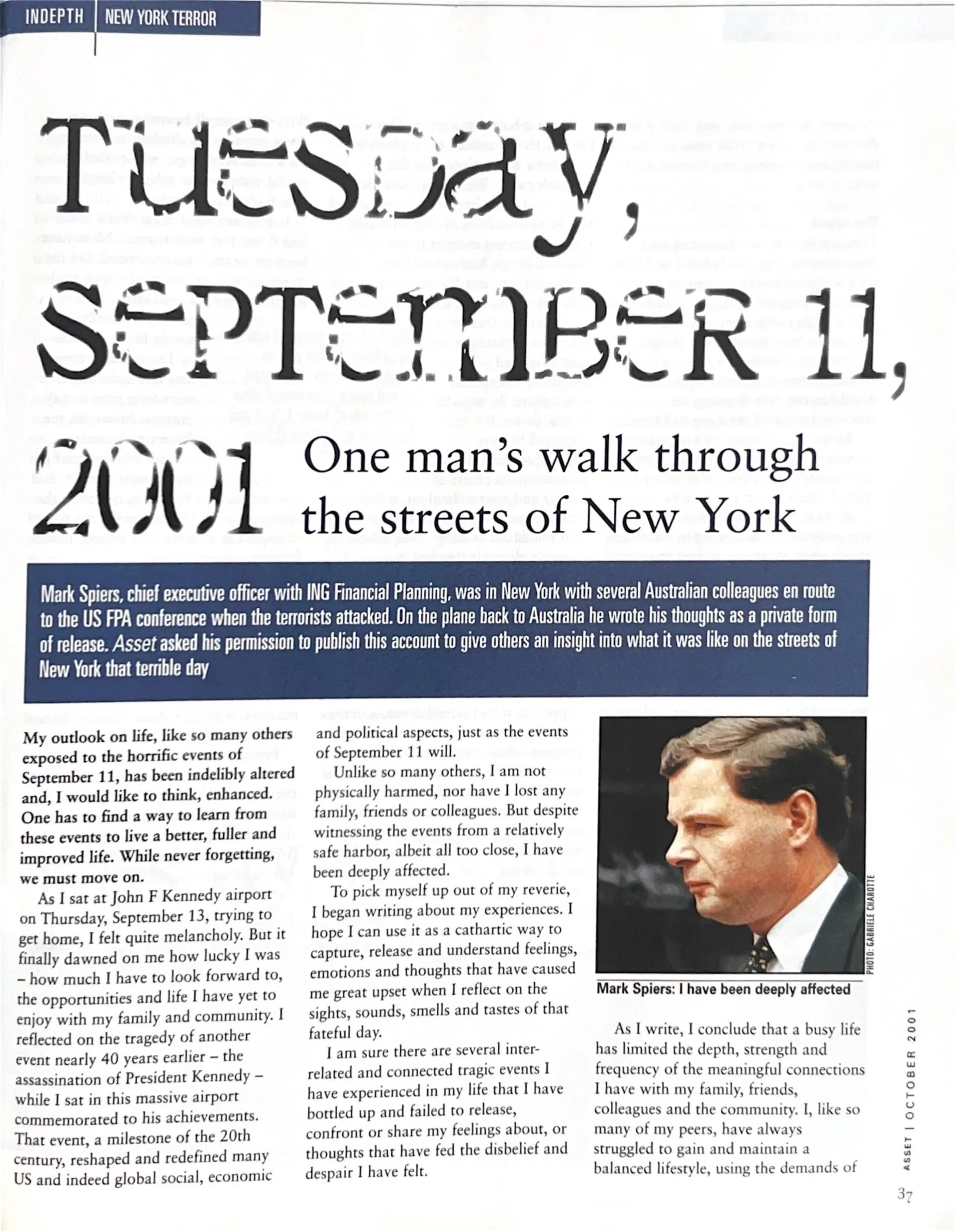
Out on the street, we looked back only to see, and hear, Tower 2 – the southern tower that was hit halfway down by the second aircraft – implode. A lady ran out of a phone booth, throwing herself onto the ground, screaming: “No, no, no!” A couple of passersby immediately moved to console her.
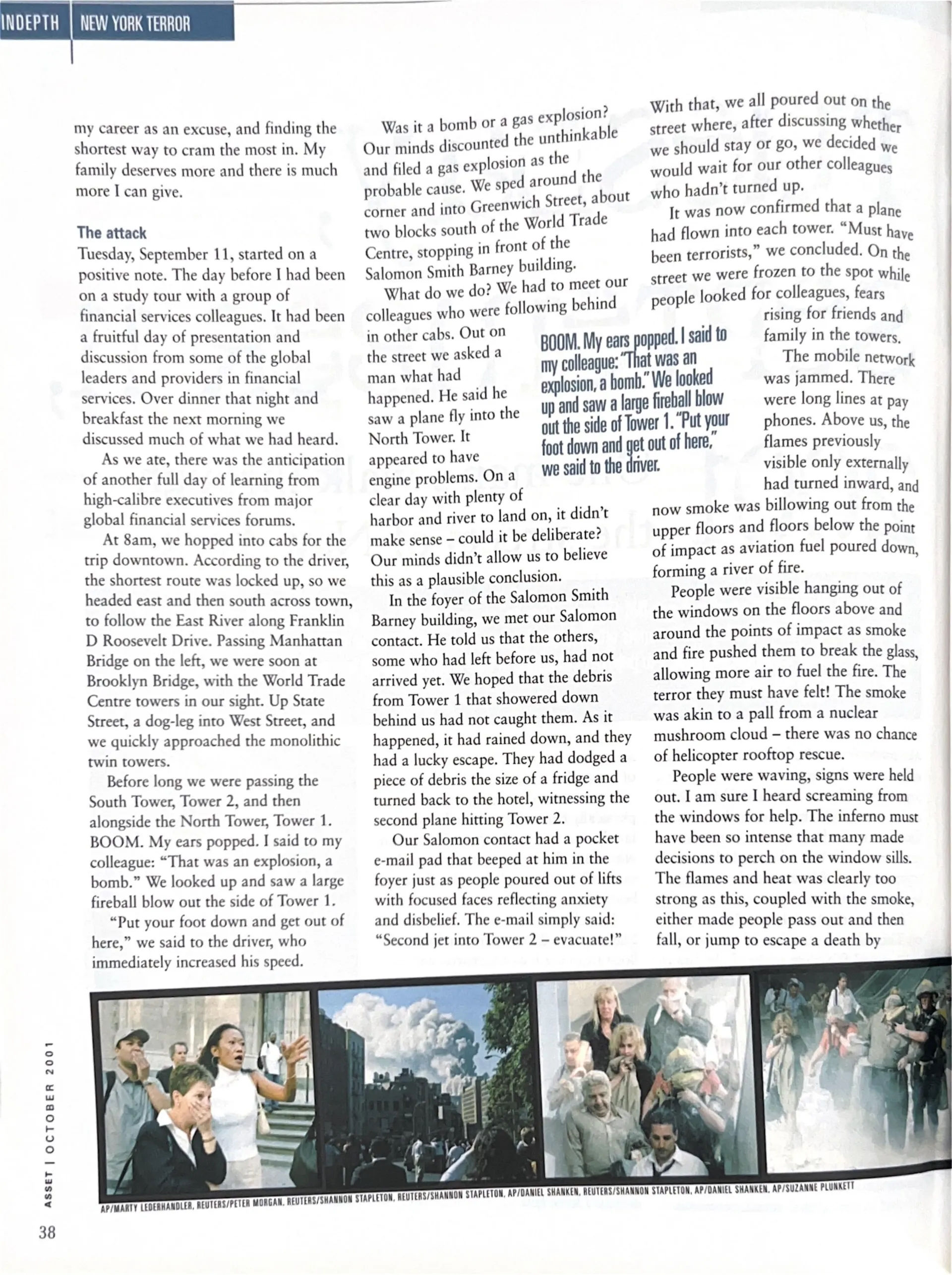
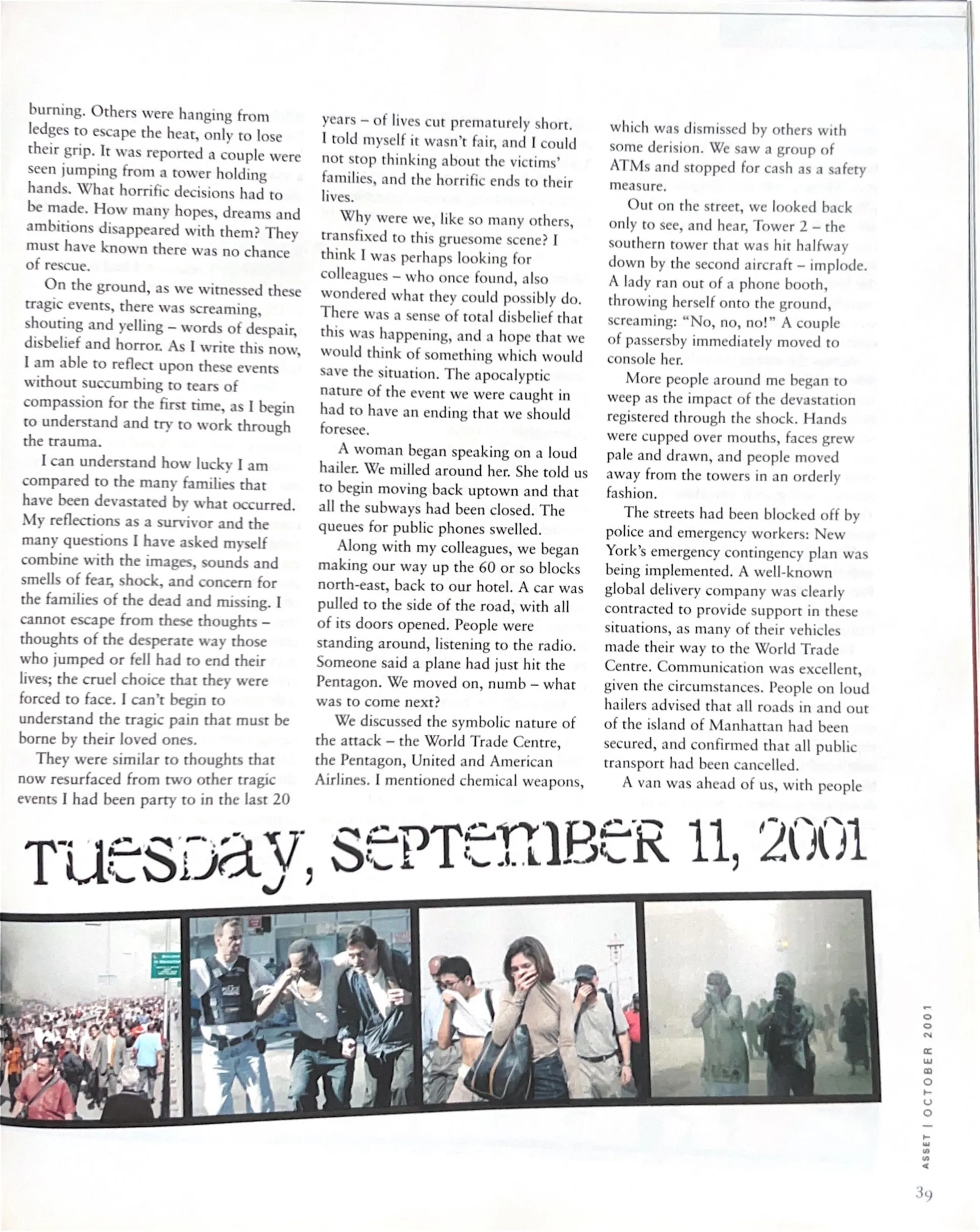
More people around me began to weep as the impact of the devastation registered through the shock. Hands were cupped over mouths, faces grew pale and drawn, and people moved away from the towers in an orderly fashion.
The streets had been blocked off by police and emergency workers: New York’s emergency contingency plan was being implemented. A well-known global delivery company was clearly contracted to provide support in these situations, as many of their vehicles made their way to the World Trade Centre. Communication was excellent, given the circumstances. People on loud hailers advised that all roads in and out of the island of Manhattan had been secured, and confirmed that all public transport had been cancelled.
A van was ahead of us, with people around it talking and following the radio coverage of unfolding events. We heard another plane had gone down in Pennsylvania, and that there were other planes the authorities were trying to account for that may have been hijacked. As we turned to walk up the steps of an overpass, always looking at the World Trade Centre, we saw the remaining tower, the north, buckle half way down the north-eastern corner and collapse into dust.
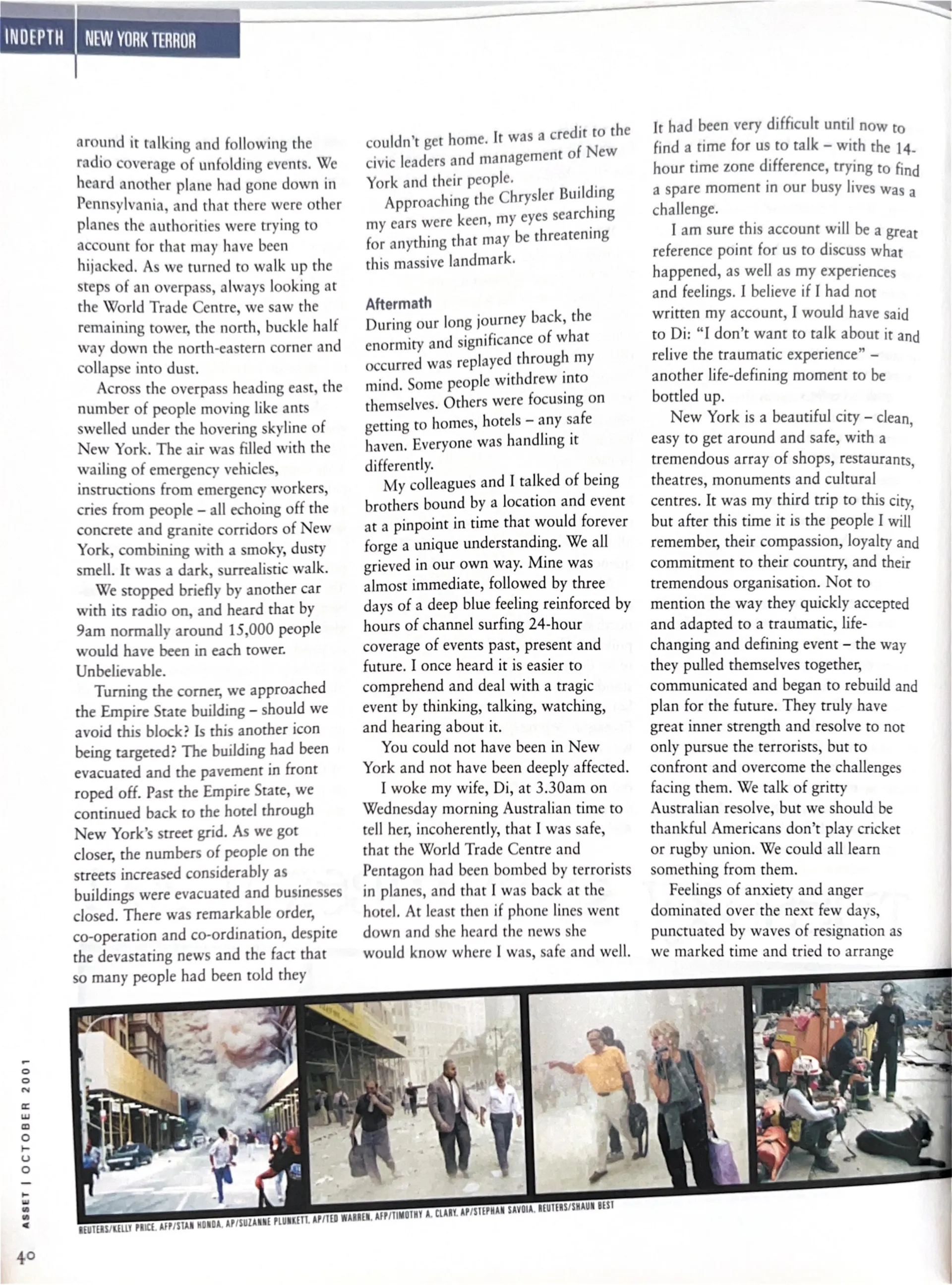
Across the overpass heading east, the number of people moving like ants swelled under the hovering skyline of New York. The air was filled with the wailing of emergency vehicles, instructions from emergency workers, cries from people – all echoing off the concrete and granite corridors of New York, combining with a smoky, dusty smell. It was a dark, surrealistic walk.
We stopped briefly by another car with its radio on, and heard that by 9am normally around 15,000 people would have been in each tower. Unbelievable.
Turning the corner, we approached the Empire State building – should we avoid this block? Is this another icon being targeted? The building had been evacuated and the pavement in front roped off. Past the Empire State, we continued back to the hotel through New York’s street grid. As we got closer, the numbers of people on the streets increased considerably as buildings were evacuated and businesses closed. There was remarkable order, co-operation and co-ordination, despite the devastating news and the fact that so many people had been told they couldn’t get home. It was a credit to the civic leaders and management of New York and their people.
Approaching the Chrysler Building my ears were keen, my eyes searching for anything that may be threatening this massive landmark.
Aftermath
During our long journey back, the enormity and significance of what occurred was replayed through my mind. Some people withdrew into themselves. Others were focusing on getting to homes, hotels – any safe haven. Everyone was handling it differently.
My colleagues and I talked of being brothers bound by a location and event at a pinpoint in time that would forever forge a unique understanding. We all grieved in our own way. Mine was almost immediate, followed by three days of a deep blue feeling reinforced by hours of channel surfing 24-hour coverage of events past, present and future. I once heard it is easier to comprehend and deal with a tragic event by thinking, talking, watching, and hearing about it.
You could not have been in New York and not have been deeply affected. I woke my wife, Di, at 3.30am on Wednesday morning Australian time to tell her, incoherently, that I was safe, that the World Trade Centre and Pentagon had been bombed by terrorists in planes, and that I was back at the hotel. At least then if phone lines went down and she heard the news she would know where I was, safe and well.
It had been very difficult until now to find a time for us to talk – with the 14-hour time zone difference, trying to find a spare moment in our busy lives was a challenge.
I am sure this account will be a great reference point for us to discuss what happened, as well as my experiences and feelings. I believe if I had not written my account, I would have said to Di: “I don’t want to talk about it and relive the traumatic experience” – another life-defining moment to be bottled up.
New York is a beautiful city – clean, easy to get around and safe, with a tremendous array of shops, restaurants, theatres, monuments and cultural centres. It was my third trip to this city, but after this time it is the people I will remember, their compassion, loyalty and commitment to their country, and their tremendous organisation. Not to mention the way they quickly accepted and adapted to a traumatic, life-changing and defining event – the way they pulled themselves together, communicated and began to rebuild and plan for the future. They truly have great inner strength and resolve to not only pursue the terrorists, but to confront and overcome the challenges facing them. We talk of gritty Australian resolve, but we should be thankful Americans don’t play cricket or rugby union. We could all learn something from them.
Feelings of anxiety and anger dominated over the next few days, punctuated by waves of resignation as we marked time and tried to arrange flights through a chaotic airline booking system, only amplified by the demise of Ansett in Australia.
Trying to get home
On Thursday at 2pm, I was advised that JFK International had just been opened and that American Airlines had put on a flight at 5pm to Los Angeles. I quickly threw everything into a case and offered the taxi driver a generous tip if he could get me there by 3.30pm. Arriving at JFK and getting re-ticketed, I made it through all the security checks and to the gate by 4.30pm.
At 5.15pm, we boarded the plane.
At 7pm, the plane was still sitting on the tarmac. Passengers around me had red eyes and drawn faces. A tense feeling prevailed. I really needed to get out of here and back home.
At 7.30pm, the captain said the flight was cancelled and the airport would be closed again until further notice.
So 11 hours after leaving Manhattan, I was back in another hotel, ready to resume the grind of calling airports to see if they were open and travel agents to secure a flight – anything to get me home. The phone lines were still jammed, and when I managed to get through it was a one- to two-hour wait, which concluded with my being told there were no flights, or all flights were booked, or the airport would be closed until further notice.
In Australia, the hustle for flights, attention and service was amplified as news of Ansett’s demise triggered a mad scramble for Qantas.
As for the internet, the sites were either down, not up-to-date or jammed – that was if I could get a line. The self-help inquiry numbers, which had AVR (activated voice response), were the easiest to get through to. However, they had trouble understanding an Australian accent. So after being disconnected for the sixth time, I finally perfected a US twang.
“What city do you want to depart from?” the software asked.
“Noo Yark,” I replied, and went on to the next question.
Watching CNN while calling the AVR service and the airline was the best way to check and validate bookings. The next day I was up at 3am to get to JFK. Three hours before the flight, the queue was already long. But no-one was grumbling about the extra security – the bag searches, the extra scans, the ID checks.
Take off – and what a feeling of elation. Roughly 94 hours after the first plane flew into the World Trade Centre, I was heading home.
Back home
What of the feelings and anxieties of the people back home? I had no idea how hard and worrisome it had been for them. I looked forward to using this as a springboard to a greater appreciation of life.
The catastrophic events of September 11 drastically changed and redefined the world’s social, political and economic attitudes, behaviors and parameters. New York, Washington and Pennsylvania were the epicentre for shockwaves that will impact the way we work, live and love for generations to come.
We all will harbor feelings of some kind – we should recognise and understand them and use them to learn to live in better and wise ways.
To the many families, friends and colleagues who lost loved ones – my heart goes out to you. I can only imagine your anguish and pain as you look for information and explanation.
The activation of Manhattan’s emergency plan was flawless. The commitment and energy of the rescue teams, and the incredible compassion and support of all Americans was simply amazing. In time, I hope that they can all find some inner peace.
Everyone has their own story – this has been mine.
ENDS